

Transparent reporting is more important than focusing on ranking bragging, as it shows what truly grows your business: leads, conversions, and revenue. Ranking reports just indicate keyword positions that don’t reflect what customers see or how much money you’re making.
We are Octillion Corp, and we help Australian businesses track these metrics. When teams can clearly understand these numbers, they make better decisions and increase revenue.
In this article, we’ll cover what transparent reporting looks like and why ranking reports fail businesses. You’ll also learn what metrics you should track instead, plus the biggest reporting mistakes to avoid.
Ready? Let’s get started.
What Is Transparent SEO Reporting?

Transparent SEO reporting means sharing raw data from tools like Google Analytics and Google Search Console. It also involves explaining metrics in plain language and providing context for every change, like traffic going up or down.
Time to get into more detail about these reports.
Real Data Without Manipulation
One of the positive things about clear-cut SEO reporting is that you receive the actual numbers. Suppose your traffic went down. Then you’ll know that it went down without having to analyze data. Likewise, if your conversions improved, you see exactly how many new leads came in (honestly, that clarity feels rare).
But where do these data come from?
Your agency pulls them straight from Google Analytics without going through any data analysis process. Specifically, they show you screenshots with dates, compare month-over-month performance, and never hide metrics that appear unimpressive.
Clear Explanations Without Jargon
The truth is, nobody needs a PhD in data analysis to understand their search engine optimization report. So, if your agency provides a transparent record to you, they will do it without adding complex ideas from regression analysis that make reports harder to follow.
The best part is you’ll actually know what you’re paying for. When your report says “bounce rate increased by 12%,” your agency explains that means more people left your site without clicking anything, and why it happened.
Here’s another example. Instead of throwing around terms like “SERP volatility,” your agency will say “Google changed how it ranks pages.”
See how much easier it becomes when you get clear reports?
Regular Updates With Full Context

A lot of people think monthly reports are just data dumps, whereas in reality, they tell the story behind the numbers.
For instance, your agency will send updates showing what changed since last month while avoiding unnecessary statistical analysis that complicates simple trends. They’ll also share why it changed, and what it holds for next month. That means if your traffic dropped, they’ll explain if it was seasonal, an algorithm update that hit everyone, or something specific to your site.
Context like that is important for making new decisions. Once you know that your competitor also lost 20% traffic, you wouldn’t feel like going overboard with your judgments (which is all you required).
Pro tip: Layer CRM data over your SEO traffic to see which keywords bring high-value customers.
Why Do Ranking Reports Fail Businesses?
Ranking reports fail because they show keyword positions without providing the quantitative data that tells the actual story. Not only that, but they also don’t connect to authentic revenue or leads and focus on useless metrics.
Here’s a detailed list of why these reports damage your business:
- Personalized Search Results: Google shows different rankings based on location and search history. That means your agency’s report might say position three, but customers in different cities see completely different results. Ranking tools can’t capture this personalization.
- No Revenue Connection: You could rank number one for a dozen keywords and still make zero dollars if those keywords don’t bring in buyers. For example, a plumber ranking first for “history of plumbing” won’t get emergency repair calls.
- Vanity Metrics Hide Problems: Large numbers can sound great, yet mean absolutely nothing. Like, you might see 50,000 impressions but get only 200 clicks. In the same manner, your domain authority might rise, but traffic and conversions remain down.
When the reports mislead you, you end up fixing problems you never had.
What Should You Track Instead of Rankings?
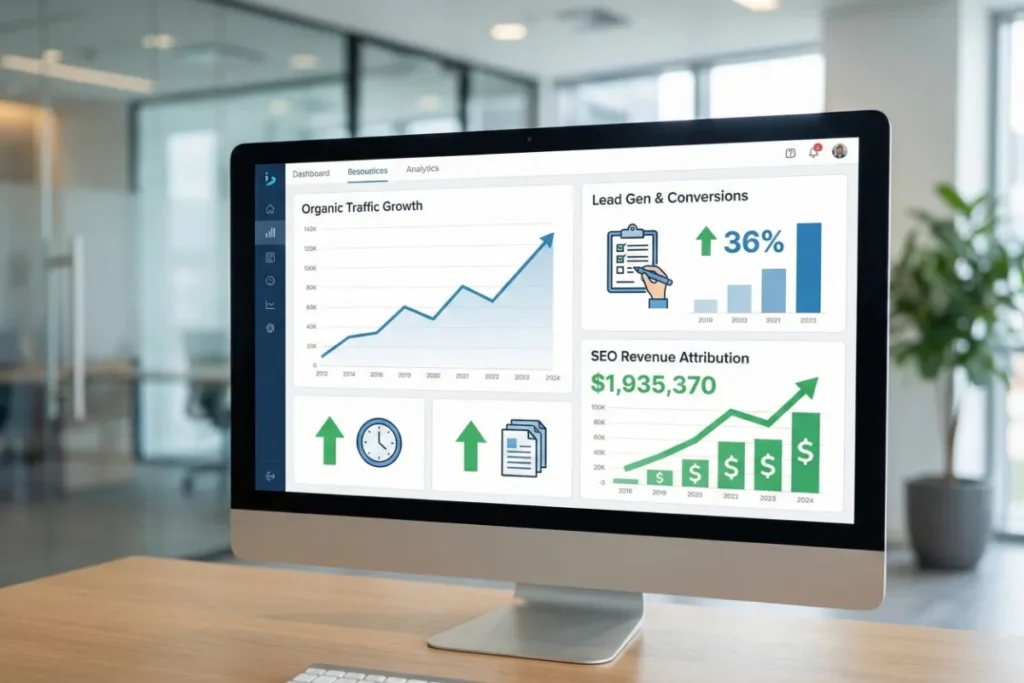
You should track organic traffic from qualified visitors, lead and conversion rates, and revenue that comes directly from SEO. In our experience, many data analysis methods used in ranking reports are misleading.
We’ll walk you through each of the metrics now.
Organic Traffic From Qualified Visitors
You should monitor monthly organic search traffic trends using Google Analytics data. But wait, don’t just count visitors. Here’s why.
A jump from 5,000 to 8,000 monthly visitors sounds great until you realize half of them are bouncing within five seconds. An automated SEO reporting tool usually misinterprets those numbers. Rather, you want people who stick around, click through multiple pages, and actually read your content (that’s what counts in the end).
Also, don’t forget to track if visitors match your target audience and customer profile. Plus, measure time on site and pages viewed per session to figure out if you’re attracting the right crowd or just random traffic that does nothing for your business.
Lead Generation and Conversion Rates
We recommend counting form submissions and demo requests from organic search visits, and you can track this without using data mining techniques. These people are raising their hands, saying they want to talk to you.
Take this example. If 10,000 people visit your site and only 20 fill out a contact form, that’s a 0.2% conversion rate. That’s why you should calculate how many organic visitors convert into qualified leads each month, then watch this number over time for a clearer picture. It’s a simple step that doesn’t require advanced data analysis techniques.
Pro tip: Track conversion rate improvements after implementing SEO strategy changes. This way, you’ll know what’s working.
Revenue Attribution From SEO
It’s important to connect your organic traffic to sales with the help of quantitative analysis. And tools like Google Analytics ecommerce tracking make that easy. For instance, if you see that a $5,000 SEO investment brought in $25,000 in sales, that’s an obvious win.
The idea behind tracking these numbers is clear: you can show that every dollar spent on SEO returns five dollars in revenue (suddenly, nobody questions your budget).
What Are the Biggest SEO Reporting Mistakes?

The biggest SEO reporting mistakes include overwhelming clients with too much data but zero insights and reporting activities instead of results. These errors destroy trust and make clients question whether SEO is even worth the money.
Avoid the following SEO reporting mistakes:
- Drowning Clients in Data: When you send fifty-page reports filled with unnecessary statistical modeling (complex math-based analyses for interpreting data and making predictions), it doesn’t help anyone. What happens in reality is that your client opens the PDF, sees 30 graphs, and has no idea what any of it means or what to do next.
- Reporting Efforts Instead of Outcomes: Listing completed tasks like “published 12 blog posts” means nothing if those articles brought in zero leads. Rather, make it a habit of showing how it impacted their business and not just how busy you were last month.
- Missing Context and Benchmarks: Has your client’s traffic dropped? Be sure to check the competitor’s traffic as well. Clients panic when agencies don’t mention that competitors dropped even harder due to algorithm updates. So, always compare against industry trends and previous performance baselines.
- Mixing Branded and Non-branded Keywords: If you put all keyword performance together, it hides the real picture, even if the data visualization looks clean at first glance. Like, you might rank first for your company name, but nowhere for terms that actually bring new customers.
- Relying on One Data Source: The worst thing about single-tool reporting is that it feels precise while being completely wrong. For this reason, we suggest tracking trends over time instead of fixating on exact numbers from a single source.
So what’s the takeaway? Simpler reporting would save everyone’s sanity.
Your Next Steps With SEO Reporting
Now you know why you should stop accepting reports that brag about keyword positions while hiding the important metrics. You deserve to see organic traffic trends, conversion rates, and revenue attribution.
In other words, transparent SEO reporting is how you know your investment is working.
If you’re ready to work with an affordable SEO agency in Australia, contact us today. Let us help you with clear data that connects directly to your business goals.