

If your business isn’t showing up when nearby customers search for what you offer, you’re handing sales to competitors who are actively ranking. Because search engines send ready-to-buy customers to whoever shows up first.
In 2026, local visibility is essential for small businesses to attract high-intent customers. Local SEO helps make this possible by helping your business appear in relevant searches when customers are ready to act.
This guide walks you through the most effective local SEO tips, from setting up your Google Business Profile to tracking what drives results. And by the end, you’ll have a clear plan you can start using right away.
What Is Local SEO and Why It Directly Impacts Local Revenue
Local SEO is the practice of optimizing your online presence so you show up when nearby customers search for what you offer.
And where you appear is important, because most people don’t scroll past the first few results. The top three listings tend to capture most of the clicks, and the map pack usually takes the largest share (the three businesses shown in Google’s map results). If you’re not there, you’re essentially missing most of the visibility in your area.
But the thing is, visibility alone isn’t what makes local SEO powerful. What truly sets it apart from regular SEO is intent, which refers to what a person is trying to accomplish when they search.
For example, someone searching “emergency plumber in Dallas” isn’t just looking for information. They need help immediately and are usually ready to contact or hire a business.
That kind of high-intent search often converts at a much higher rate than general research queries. For small businesses, this means reaching the right people in your area at the moment they’re ready to act, and that’s exactly what local SEO helps you do.
Local SEO vs. Traditional SEO: What Changes When You Go Local?
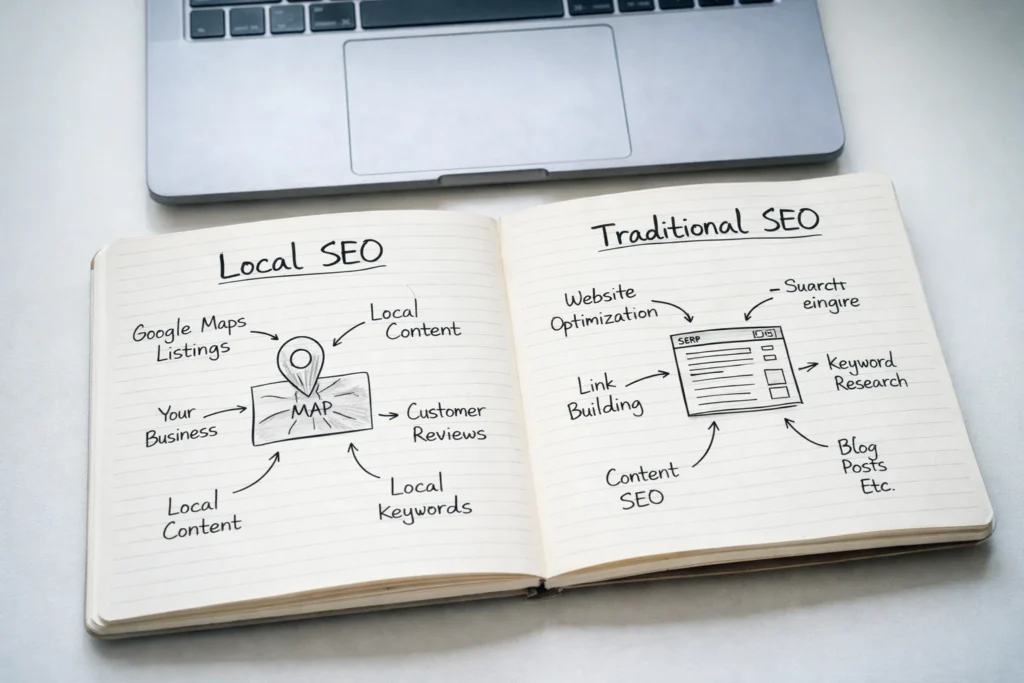
You could rank on page one nationally and still not attract local customers. That’s exactly the gap local SEO is designed to close.
| Traditional SEO | Local SEO | |
| Target Audience | Broad, nationwide or global | Nearby customers in a specific location |
| Ranking Factors | Content, backlinks, site authority | Proximity, Google Business Profile, local citations |
| Google Search Results | Standard blue link results | Map pack, local search results |
| Keywords | General terms | Location-based keywords |
| Goal | Drive overall website traffic | Drive foot traffic and local leads |
Traditional SEO focuses heavily on content quality, backlinks, and domain authority, while local SEO adds physical proximity as a major ranking factor. Google considers how close your business is to the searcher, which means two businesses with identical websites can rank completely differently depending on their location.
That’s why local businesses need a different strategy than national brands. Ranking nationally doesn’t guarantee you’ll show up in your own area.
Optimizing Your Google Business Profile for Maximum Local Visibility
A fully optimized Google Business Profile puts your business on Google Maps and in the local pack, right where high-intent customers are searching. It’s free, yet most businesses only complete the basics and leave significant visibility on the table.
Let’s start with the details many businesses overlook.
The Core Business Details That Influence Rankings First
To get your listing up and running, start with these core details:
- Your business name
- Address and phone number
- Business category
- Hours of operation
- Website URL
- Service areas
When you fill in every available field, Google has more to work with when matching your profile to nearby searches. Think of it like a job application. The more complete it is, the better your chances of getting noticed.
Photos, Posts, and Overlooked Competitive Signals
We’ve seen plenty of business owners upload a couple of photos at setup and never return. Meanwhile, their competitors keep updating and that consistency doesn’t go unnoticed.
Regular photo uploads and posts signal that a listing is active. That activity can influence how often your business appears in local results compared to competitors with stale profiles. Even small updates, like adding a photo or posting a weekly offer, keep your listing fresh.
And businesses that go months without updates often see their visibility slip, even if their reviews and other factors stay strong.
Building Local Citations That Strengthen Trust and Rankings
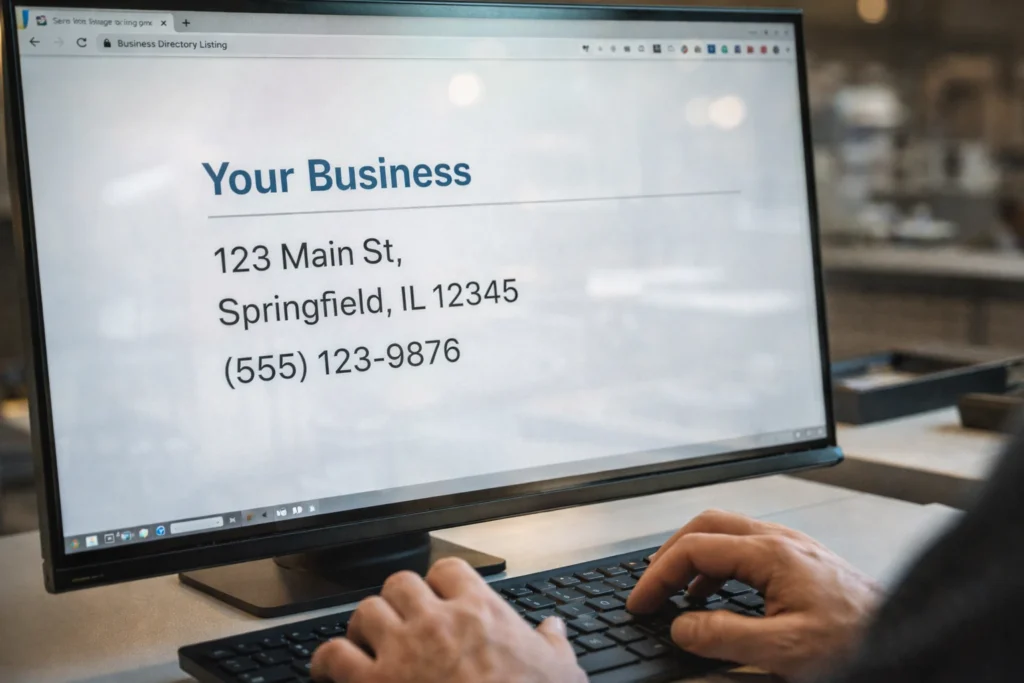
A local citation is any online mention of your business name, address, and phone number (NAP). The more places this information appears accurately, the more confident Google becomes that your business is legitimate and should rank for local searches.
Here’s what to focus on:
- NAP Consistency: Your business name, address, and phone number should match as closely as possible across every directory. Even small differences, like “St.” vs “Street” or including/excluding suite numbers, can create conflicting signals that affect your rankings. So audit your listings quarterly to catch inconsistencies before they become a problem.
- General Directories: Established platforms like Google Business Profile, Yelp, Foursquare, and your local chamber of commerce are reliable places to build your presence. Google trusts these directories, and they generate enough traffic to put your listing in front of potential customers actively searching in your area.
- Industry-Specific Directories: The more relevant your directories are to your field, the stronger the signal you send to Google. A restaurant benefits from profiles on TripAdvisor and OpenTable, while a contractor gets more visibility through Houzz. These category-specific listings reinforce what your business does, which improves your chances of showing up in local searches within your niche.
- Avoid Low-Quality Directories: Not every directory is worth your time. Sites with thin content, excessive ads, or no real traffic may harm your credibility with Google, so focus on directories where your target customers are actually searching.
We recommend building 10-15 quality citations across general and industry-specific directories. It’s better to have accurate information on 15 directories than inconsistent listings across 50.
Local Keyword Strategy: Finding and Using Search Terms That Convert
Local keywords help connect your business with customers who’re ready to hire. For example, someone searching “landscaping tips” is likely browsing for information, while someone searching “landscaper in Portland” is probably ready to hire help right away.
Local keywords combine what you offer with a specific location, pulling in people who are ready to hire. Plus, the difference between ranking and not ranking often comes down to using them in the best places.
Where Local Keywords Belong on Your Website

Your Google Business Profile tells Google where you are and what you do. Your website needs to reinforce that with local keywords in page titles, headers, meta descriptions, and body content. Without those location signals, Google can’t confidently match your site to local searches.
From there, each service page should target a specific location and service combination. For example, “residential landscaping in Northeast Portland” instead of just “landscaping services.” This specificity helps Google match your pages to relevant search queries from your area.
How to Find Local Keywords Worth Targeting
Start with Google Keyword Planner to see which location-based terms get searched in your area. Search volume tells you whether “Portland landscaper” gets more searches than “Portland lawn care,” data that replaces guessing.
Tools like Ahrefs and Semrush go further by showing keyword difficulty and what competitors rank for. This helps you prioritize terms you can realistically win instead of chasing impossible keywords. If “landscaper Portland” has 50 competing businesses, but “landscape design West Linn” has 5, the easier target makes more sense for your strategy.
Together, these tools build a keyword list based on actual search behavior, not assumptions.
Getting Customer Reviews and Putting Them to Work
Reviews are one of the strongest ranking factors in local search. A recent Search Atlas study found that for businesses ranking in positions 1 through 21, review count influences about 19% of ranking decisions. But in the top ten, that numberrises to 26%, which means reviews become even more important as you move closer to the first position.
Review keyword relevance also plays an important role here. The words customers use in their reviews account for about 22% of the top ten rankings. That means a review mentioning phrases like “fast plumbing repair in Austin” can help your rankings more than a generic “great service” review.
But reviews don’t just influence rankings, they influence decisions, as well. People often read reviews before contacting a local business, and what they find often determines whether they call you or your competitor.
Thankfully, getting more reviews doesn’t require a complicated system. You just have to ask. It could be in person, via email, or through your social media platforms. Most happy customers are willing to leave a review. They just need a small nudge.
Measuring Your Local SEO Performance Without the Noise

Local SEO isn’t about watching graphs go up. It’s about real customers taking action. To see whether your efforts are translating into business growth, keep an eye on these four areas:
- Map Pack Rankings: Your position in the local pack is one of the clearest indicators of how your local SEO is performing. Tools like BrightLocal or Google Search Console help you monitor your keyword positions over time, so you can see whether your efforts are paying off.
- Google Business Profile Insights: If you want a quick read on how your listing is performing, your Business Profile dashboard is the place to check. It shows how many people viewed your profile, clicked your website, or asked for directions. Those actions tell you whether people are discovering your business and taking the next step.
- Review Velocity: It’s not just about how many reviews you have, it’s also about how consistently you’re getting new ones. A steady stream of fresh reviews signals to Google that your business is active, which supports your rankings consistently.
- Website Traffic from Local Searches: Google Analytics lets you filter traffic by location, showing how many visitors are coming from your target area. If that number is growing alongside your ranking improvements, it’s a good sign your SEO growth is heading in the right direction.
Check these regularly, and you’ll quickly see which actions lifted your rankings and which ones wasted your time.
Ready to Show Up Where Your Customers Are Looking?
Local SEO rewards consistency more than budget. The local businesses that show up first aren’t always the biggest or most established. They’re usually the ones who got the basics right and kept showing up.
Start with your Google Business Profile, build your local citations, and create content that targets the search terms your customers are actually using. These are the best practices that move the needle for most small businesses, and none of them requires a big budget.
If you want help putting these local SEO tips into action, Octillion Corp works with local businesses across Australia to build search visibility that actually drives results. Reach out and let’s talk about what’s possible for your business.