

Have your rankings refused to improve for months? Your content is strong and your site is fine, yet you still can’t reach the top 10.
A few simple tweaks can help Google notice you, and it’s okay if you’re unsure where to begin. At Octillion Corp, we’ve helped businesses climb from the bottom of search results to top positions, which earned them genuine traffic.
In this guide, we’ll walk you through realistic SEO timelines for 2026 and why you’re stuck between page 5 and 10. You’ll also learn how to build an effective SEO growth plan, plus quick wins that move you up fast.
Read on to learn which easy fixes can help you show up higher on Google.
What Is a Realistic SEO Growth Timeline for 2026?

Most SEO campaigns take 4 to 12 months to show results. The smaller impacts start to appear around month 3, and bigger ranking jumps occur after month 6.
That timeline might feel long (we get it). But the thing is, Google needs time to crawl your site, index your changes, and decide if you deserve those top spots.
According to Ahrefs on their page “How Long Does It Take to Rank in Google? And How Old Are Top Ranking Pages?”, only 1.74% of newly published pages rank in the Top 10 within their first year. The other 98.26% either never reach the Top 10 or take much longer.
Let’s break down what happens at each stage of the timeline.
Early Improvements in Months 1 to 3
In the earlier months, Google Search Console shows which pages of your site need instant technical SEO fixes. To find those pages, just open the Coverage report, and you’ll see crawl errors, indexing problems, and pages that aren’t showing up in search results yet.
Another thing you must do during this period is target low keyword difficulty terms first. They’ll help you rank much more easily early. In your keyword research, try to look for keywords with 100 to 1,000 monthly searches and difficulty scores under 30, and publish content on them.
Besides, you have to fix broken links and slow page speed issues to stop losing your visitors’ trust. If someone lands on your page, clicks a dead link, and bounces, Google will notice it and drop you further down the search engine results page (SERP).
Steady Progress Between Months 4 and 6
You should start seeing some improvement in your ranking after the initial three months. For starters, your keyword rankings should climb because that’s when Google would begin recognizing your on-page optimization work.
However, you might not jump straight from position 49 to 15. Rather, it might be something like going from 49 to 24 and then reaching 15. That’s not page 1, but still, it’s some actual movement (this is the first sign you’re on track).
This is also the time you should start working on internal links. They direct search engines on how your pages connect and relate together. Kick off your process by linking your strong pages to weaker ones. Doing so will tell Google that those pages, too, are important, and it speeds up how fast Google understands your site.
Then there are meta descriptions and page titles. If you write them properly, they’ll attract more clicks from search results.
To understand how you should write your descriptions and titles, check the top 3 results for your keyword. You’ll notice that their titles promise something specific, use numbers, or create curiosity. You should do the same with yours.
Significant Growth From Months 7 to 12
Did you know that when trusted websites link to your content, it boosts your site’s authority? One link from a high-quality site (Domain Authority or DA 50 ) is worth more than 20 links from random blogs (quality wins every time).
Also, organic search traffic improves when you keep up with content creation and keyword optimization month after month. By month 9, you could see double the visitors. And by month 12, that number might double again if you remain consistent with your work.
Last but not least, you should also start ranking for competitive terms with higher search volume by now. This was the dream in month 1, right?
Pro tip: Rewrite outdated H2s and H3s using modern search phrasing. Updating headers alone can influence major jumps in Google search ranking.
Why Are You Stuck Between Page 5 and Page 10?

Pages stuck between 5 and 10 usually have one or more problems, like content that misses search intent and keyword cannibalization. It may also be anything from weak backlinks, poor mobile experience, missing on-page optimization, or low click-through rates.
Here’s a detailed list of why these issues are holding you back:
- Search Intent Mismatch: Let’s say someone types “best running shoes” (commercial intent keyword), but your page just explains what running shoes are. Commercial intent keywords need product pages and not blog posts. Now you know why your rankings aren’t improving.
- Keyword Cannibalization: Multiple pages fighting for one focus keyword confuses Google completely. For example, if you have three posts about “email marketing tips,” Google can’t decide which one deserves the top spot. As a solution, we recommend merging similar content into one page and redirecting old URLs.
- Weak Backlinks: Guess what happens when your competitors have 50+ backlinks from sites with a Domain Authority above 40? They rank better than you because search engine ranking depends on backlinks as a direct ranking factor. That’s why a single link from Forbes beats 100 links from brand-new blogs with zero traffic.
- Poor Mobile Experience: Many people don’t know that over 60% of organic search traffic comes from mobile devices. So, Google switched to mobile-first indexing, and the mobile version determines your rankings now. You need to improve your mobile site if you want to get out of page 5 jail.
- Missing On-Page Elements: Your page title is just “Homepage,” there’s no meta description, and you have 20 images with no alt text. Your URL also looks like “yoursite.com/p?id=12345” instead of something like “yoursite.com/seo-growth-plan.” Google needs you to have these basics right to understand what your page is about.
- Low Click-Through Rates: You’re in position 8 but only get 50 clicks a month. Your competitor in position 9 gets 200. Why? Their meta description says “Get 47% More Traffic in 90 Days,” while yours just says “Learn more about SEO.”
So if it feels like Google is ignoring you… It kind of is. But now you know why.
How Do You Build an SEO Growth Plan?

A working SEO growth plan starts with an audit in Google Search Console, finding your threshold pages, and analyzing competitors. It’s also important to map keywords by difficulty, create a content calendar, and set up tracking in Google Analytics.
Follow the 6 steps below as a comprehensive SEO growth strategy:
- Audit in Search Console: Open Google Search Console and check which pages get impressions but have terrible click-through rates. Look for crawl errors stopping search engines from indexing your content. Then find out which target keywords already send you some organic traffic.
- Find Threshold Pages: Pages ranking on page 2 are easiest to push into the top 10. They already have some authority and existing keyword rankings. Just committing small tweaks to titles, content, or some internal links can move them into money-making positions quickly.
- Analyze Competitors: You need to compare your content with pages that already rank well. That’s where tools like Ahrefs and SEMrush can help you see their keyword strategies fast. Your goal is to find topics your audience wants but no one explains well.
- Map Keywords: Google Keyword Planner is the best free tool to find out the monthly search volume for every target keyword. To get the best output from it, we recommend balancing high-volume terms with realistic difficulty scores for your domain size. Pick keywords where search intent actually matches what your page offers.
- Create Content Calendar: Plan content around keywords driving the most organic search results. Target different stages of your customer journey, from awareness to purchase. When you publish content constantly, it tells Google your site is active and relevant.
- Set Up Analytics: Don’t forget to monitor organic traffic trends and conversion rates every month in Google Analytics. Track which pages actually drive leads or sales. You also need to figure out if your search engine optimization tactics work long-term or need adjustments.
Once you do these things right, your rankings will start moving in the right direction.
What Quick Wins Move You From Page 5 to Page 1?
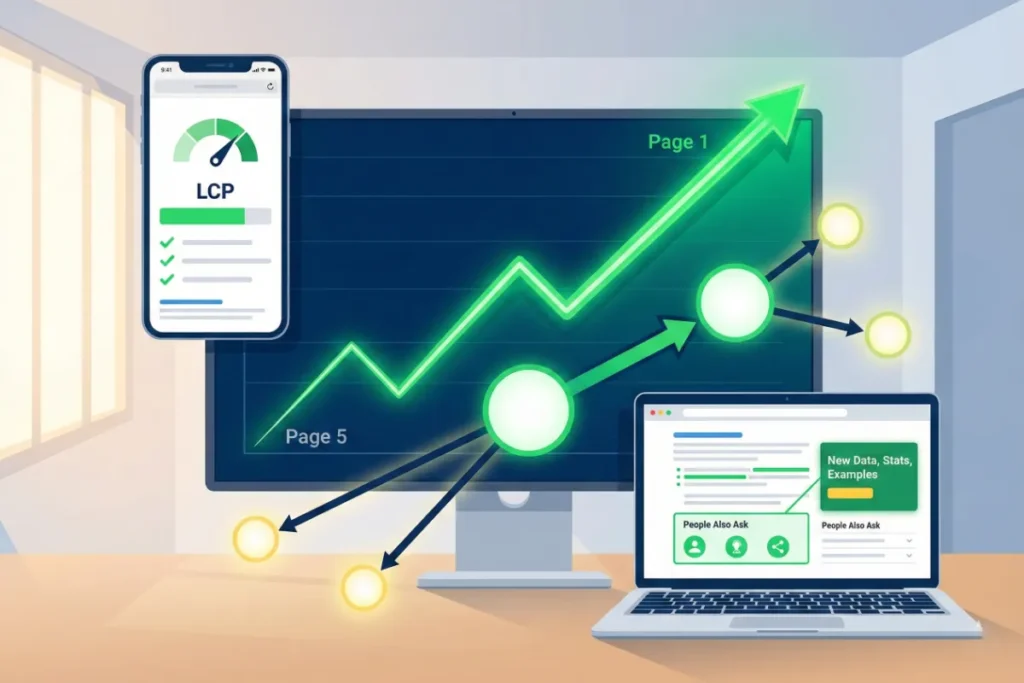
The fastest way to jump from page 5 to page 1 involves fixing your Core Web Vitals and site speed. Not just that, you should refresh existing content with new data, and add strategic internal links to underperforming pages, too.
Let us explain them in detail.
Fix Core Web Vitals and Site Speed
Slow page speed is a ranking factor that drops pages rapidly. If your site is sluggish, take some help from Core Web Vitals. It measures loading speed and stability on mobile devices for ranking.
Just remember that your Largest Contentful Paint (LCP) needs to be under 2.5 seconds, and Cumulative Layout Shift (CLS) should stay below 0.1. That’s it.
But that’s not all. You can further speed up your website through some technical SEO practices, like image optimization, removing unused JavaScript, and enabling browser caching. These tweaks can cut your load time in half and improve both your rankings and user experience.
Pro tip: Serve fonts locally instead of pulling them from external CDNs. Font render delays are one of the biggest hidden LCP issues.
Refresh Existing Content With New Data
It’s important to update your old pages with new stats to keep the content relevant today. For instance, if a post from 2022 still has outdated numbers, replace them with 2026 data and fresh examples. Google will recrawl the page much faster.
And once the basics are updated, add a few new sections that answer related search queries your target audience is asking right now. Checking the “People Also Ask” box for your keyword is an easy way to find 3-5 questions worth adding (Google loves it when you do this).
Believe it or not, refreshing content like this often works better than creating brand-new pages, especially when you already have some keyword rankings. This way, a page sitting at position 35 can climb to page 1 in a matter of weeks instead of months.
Add Strategic Internal Links to Underperforming Pages
Curious how to give your weak pages a quick boost in visibility? A simple way is to use internal links from your strongest web pages to lift the ones that are struggling. Start by opening Search Console to see which pages perform best.
After you find them, add 2-3 internal links pointing to the pages stuck on 5. It’ll guide both users and Google toward the content that needs attention.
When you add those links, ensure the anchor text includes relevant keywords so search engines understand how the pages relate to each other. Here’s an example: instead of vague text like “click here,” use something clearer, like “learn how to fix Core Web Vitals.”
As a bonus, internal links also spread your site’s authority and make it easier for visitors to find more of your content. These longer visits and more page views send positive signals to Google, which helps your rankings even better.
Time to Put Your SEO Growth Plan Into Action
Honestly, SEO growth takes time, but the good news is that you’re not starting from scratch. Pages already ranking between positions 11 and 50 have some authority built in, which means they’re much easier to move up.
All you need to do is clean up technical issues, refresh outdated content, and add a few strategic internal links to guide Google in the right direction.
If you want support in creating an effective SEO strategy to get your pages where they should be, reach out to us today. We’re here to help you climb the rankings.